

Vendor Due Diligence
Answers first. Documents on request.
AI Vendor Due Diligence for Banks and Credit Unions
What StandardC AI sees, who calculates the numbers, where your data lives, and what your third-party risk team can request today.
Your AI Vendor File Is the Control
The April 2026 model risk guidance (SR 26-2) places generative and agentic AI outside its formal scope and leaves governance to each institution. Third-party risk expectations still apply to every AI vendor you approve. This page answers the questions your third-party risk, model risk, and BSA teams ask about StandardC AI, in plain terms, before the questionnaire arrives.
HOW STANDARDC AI IS GOVERNED
Six Answers Your Model Risk Team Will Ask For
Each answer below is documented in the StandardC due diligence package.

Whose Rules It Follows
StandardC specialists configure each agent to your policies, risk rating matrix, thresholds, and escalation protocols. Every configuration is version controlled and logged with your institution.

How Findings Are Traced
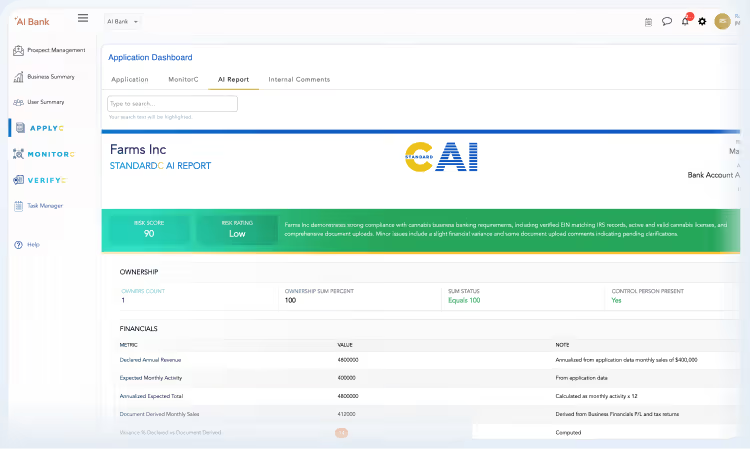
Every finding cites the source it came from. Each StandardC AI Report is archived as a PDF with an immutable audit log.

What the Model Sees
AI models never see client or related-party PII. StandardC has filed two patents on its Privacy First AI approach.

Who Makes the Decision
Your people. StandardC AI does not approve, deny, or file anything. It returns a report your analyst reads, challenges, and acts on.

Who Calculates the Numbers
Computational logic models perform every calculation, so the same inputs produce the same figures every time. Generative models draft narrative. They do not decide what the numbers are.

How Staff Use It
Users do not write prompts. Each agent runs a governed specification, so there is no free-form prompt for staff to get wrong or misuse.
Regulatory Context:
SR 26-2 (April 17, 2026) replaced SR 11-7 and SR 21-8 and places generative and agentic AI outside its formal scope. Oversight of AI vendors follows the interagency third-party risk guidance (SR 23-4, OCC Bulletin 2023-17, FDIC FIL-29-2023). A replacement was proposed in September 2026 and is not yet final.
SECURITY & ACCESS
Security Controls and Evidence

Access Controls and Single Sign-On
Role-based permissions limit who can view documentation and analysis. Enterprise institutions can sign in through their own identity provider.

Logical Tenant Isolation
StandardC is a multi-tenant SaaS platform hosted on AWS. Each institution's data is logically isolated and is never commingled with another institution's data.

SOC 2 Type II Report
An independent auditor has examined StandardC's security controls. The SOC 2 Type II report is available under NDA through the StandardC Trust Center.

Complete Audit Trail
Every input, configuration version, and reviewer action is documented with user ID and timestamp in one continuous audit trail.
DATA HANDLING
Clear Data Commitments
No Training on Your Data
Customer data is never used to train or fine-tune AI models. All processing is inference only.

Processed and Stored in the United States
Customer data is processed and stored exclusively in the United States, including processing by StandardC's third-party AI providers.
Change and Incident Notice
StandardC gives approximately 30 days of advance notice before new AI capabilities and before model version or agent logic changes, unless a change is critical. Security incidents are reported within 24 hours after triage.

Disclosed AI Providers
Narrative generation uses licensed third-party models accessed by API. Every provider is named in the due diligence package.
How does this fit into ERM?
See how StandardC maps to every function in your Enterprise Risk Management framework.
FAQ
Questions Your Third-Party Risk Team Will Ask
Does StandardC train AI models on our data?
No. Customer data is never used to train or fine-tune AI models. All processing is inference only.
Do the AI models see our customers' personal information?
No. AI models never see client or related-party PII. StandardC has filed two patents on its Privacy First AI approach.
Where is our data processed and stored?
Customer data is processed and stored exclusively in the United States, including processing by StandardC's third-party AI providers.
Is StandardC single-tenant or multi-tenant?
StandardC is a multi-tenant SaaS platform hosted on AWS. Each institution's data is logically isolated and is never commingled with another institution's data.
Which third-party AI providers does StandardC use?
Narrative generation uses licensed third-party models accessed by API. Every provider is named in the due diligence package.
Who calculates the numbers in a StandardC AI report?
Computational logic models perform every calculation, so the same inputs produce the same figures every time. Generative models draft narrative. They do not decide what the numbers are.
Does StandardC AI make decisions about our customers?
No. StandardC AI does not approve, deny, or file anything. It returns a report your analyst reads, challenges, and acts on.
How much notice do we get before the AI changes?
StandardC gives approximately 30 days of advance notice before new AI capabilities and before model version or agent logic changes, unless a change is critical. Security incidents are reported within 24 hours after triage.
Does StandardC have a SOC 2 report?
Yes. An independent auditor has examined StandardC's security controls. The SOC 2 Type II report is available under NDA through the StandardC Trust Center.
How does SR 26-2 apply to an AI vendor like StandardC?
SR 26-2, issued in April 2026, places generative and agentic AI outside formal model risk guidance and leaves governance to each institution. StandardC AI gives that governance something to test: calculations that repeat, findings that cite their source, a full audit trail, and a human decision on the record. Vendor oversight follows the interagency third-party risk guidance.
REQUEST THE DOCUMENTS
Request the StandardC Due Diligence Package
The SOC 2 Type II report, security policies, penetration test results, and continuity plans are available through the StandardC Trust Center. StandardC shares due diligence responses through the Trust Center or your institution's portal, not by email.

Deterministic
Produced within governed specifications

Privacy-First
AI models never see client PII

Audit Trail
Complete input/output trace preserved

Human Authority
Zero automated decisions, ever

Examiner-Ready
Citation-backed, governed documentation