.webp)
The Alien in the Vault: Why Banks Must Govern AI, Not Ban It or Trust It
by Robert Mann, CEO and Co-founder, StandardC
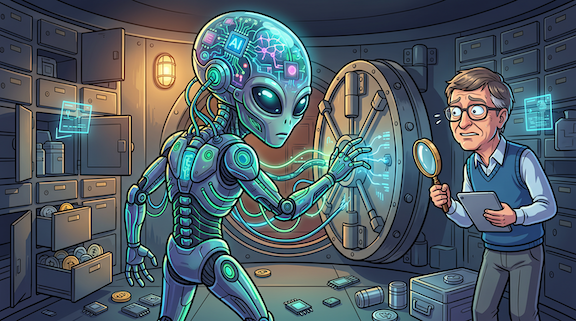
Banks should treat generative AI as an alien intelligence that must be governed, not a tool to ban or a vendor to automatically trust. In practice, that means four architectural controls are essential: remove private data before any model sees it, calculate numbers in code, trace every finding to its source, and record a human decision. Institutions that build those controls can use AI safely this year. Those that do not are already exposed.
The Alien Has Arrived
On CNN's Fareed Zakaria GPS on September 27, 2026, Bill Gates described AI as an evolutionary event, "a new alien species that is going to be smarter than we are." He warned that past technology shifts are the wrong guide this time. He also said the rest of society has not caught up to how powerful AI is, even as the industry warns about its own products.
Gates argues that a monitoring layer over AI, one that checks how it is being used, can be built without slowing progress much. That is the right frame for a bank. The question is not whether the alien gets in. It is already in, through the chatbot tab on an analyst's second monitor. The question is who watches it.
The Supernova Problem
Mike Freiling, PhD, who earned his doctorate at the MIT Artificial Intelligence Lab in 1977 and advises StandardC, saw this coming in March. In Governing the Generative AI Supernova, he likened generative AI's development to "the explosion of a supernova, scattering new cosmic elements everywhere, from black holes to nascent stars to entire planetary systems."
His warnings for financial institutions are specific:
- "PII data must always be redacted before any data is passed to any genAI platform. Guarantees of confidentiality by third-party vendors cannot be relied upon."
- "GenAI results are not designed to be repeatable."
- "Financial institutions wishing to use genAI are thus lashed to the mast of whatever platform they have chosen to utilize."
- "Constant oversight of generative AI interaction is required."
And his forecast: "If one thing is certain, it is that the genAI supernova will continue to explode."
Why Banning Fails, and Why Trusting Fails
Banks tend to pick one of two responses. Both lose.
Ban it. A ban drives use onto personal accounts, where the institution sees nothing. The work AI speeds up still has to get done, so staff find a way.
Trust it. Buying an enterprise chatbot and relying on the vendor's contract moves the risk without controlling it. An examiner will not accept "the vendor handles that." Neither will a board after an incident.
The regulators are not going to settle this for you soon. The April 2026 interagency model risk guidance (SR 26-2) leaves generative and agentic AI outside its formal scope. Examiners will still ask how every AI-assisted decision was made and who made it.
What Governing an Alien Looks Like in a Bank
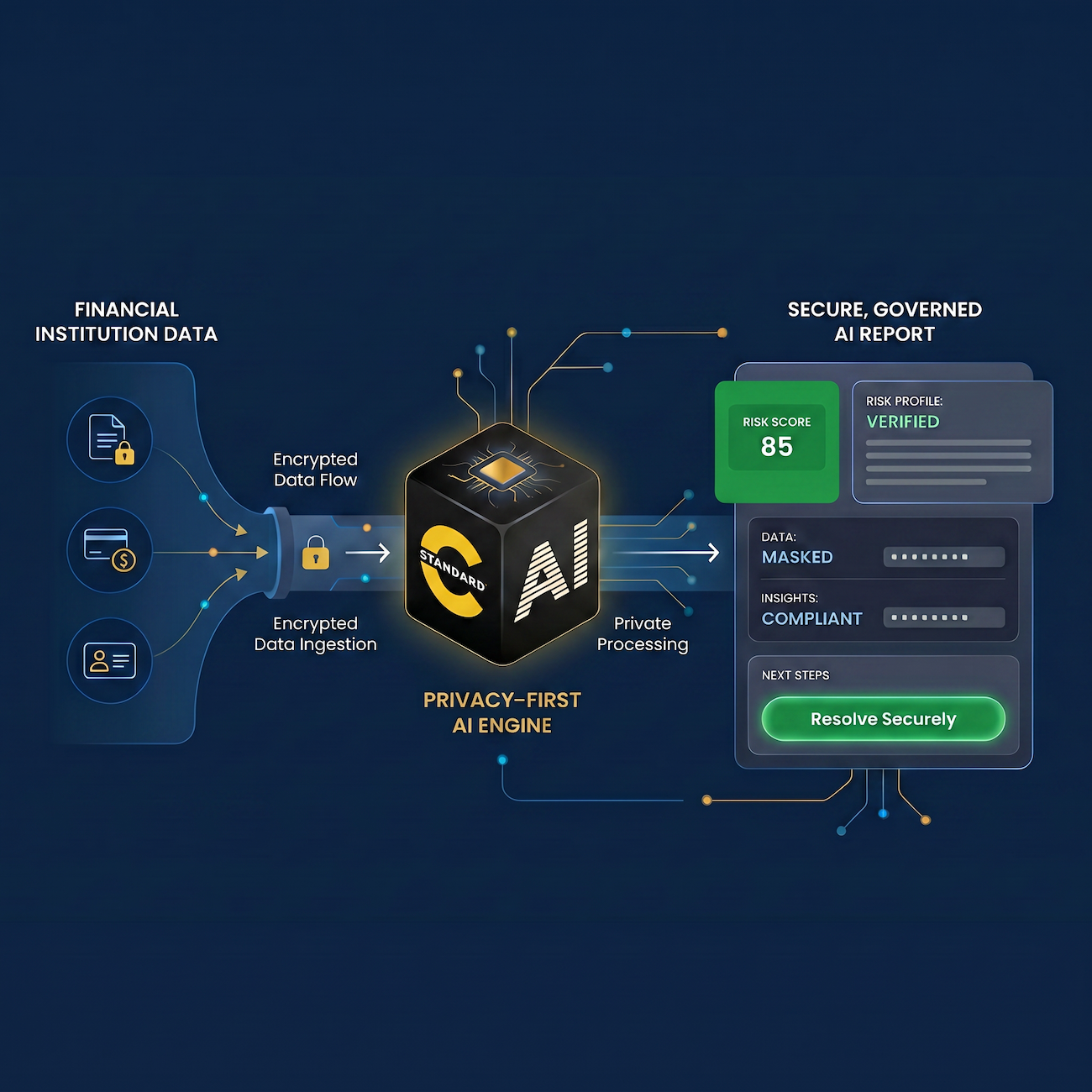
Governed AI is an architecture, not a policy. Each layer answers a question an examiner will ask.
Privacy-first preprocessing. Removes names, account numbers and other identifiers before any model sees the data. What the examiner sees: customer data never leaves the institution's control.
Deterministic processing. Ratios, totals and thresholds are calculated in code, not generated. What the examiner sees: the same file gives the same answer on every run.
Governed cognitive agents. AI drafts, summarizes and flags inside set boundaries. What the examiner sees: what the agent can and cannot do.
Examiner-grade traceability. Every finding cites its source, and a named person makes the decision. What the examiner sees: a complete record of who decided what, and why.
This is the monitoring layer Gates describes, built for a regulated institution. It lets a bank get the speed of AI without handing its judgment to an alien.
Five Questions for Your Board This Quarter
- Where is private data removed before it reaches any AI model?
- Which numbers in our AI outputs are calculated by code, and which are generated?
- Can every AI finding be traced to a source document?
- If we run the same file twice, do we get the same result?
- Where is the human decision recorded, and by whom?
If your institution or your AI vendor cannot answer all five, you are not governing the alien. You are hosting it.
Where StandardC Stands
StandardC built its platform for this moment: privacy-first preprocessing, deterministic processing, governed cognitive agents and examiner-grade traceability, for community banks, credit unions and lenders. See how StandardC AI works, or ask us to walk your team through the five questions.
Frequently Asked Questions
What did Bill Gates mean by calling AI an alien species?
On CNN's Fareed Zakaria GPS on September 27, 2026, Gates described AI as an evolutionary event in which a new intelligence smarter than people has been created. He argued past technology shifts are a poor guide, and that society has not caught up to how powerful AI is.
What is governed AI for banks?
Governed AI is an architecture in which private data is removed before any model sees it, numbers are calculated in code, every finding traces to a source, and a named person makes the final decision on the record.
Why doesn't banning AI tools protect a bank?
Bans push staff onto personal accounts the institution cannot see, because the work AI speeds up still has to get done. A governed tool that is faster and safer than the chatbot is the control that lasts.
Can a bank rely on an AI vendor's confidentiality promise?
No. As Mike Freiling, PhD, writes, vendor confidentiality guarantees cannot be relied upon, so private data should be redacted before it reaches any generative AI platform.
Does SR 26-2 cover generative AI?
No. The April 2026 interagency model risk guidance leaves generative and agentic AI outside its formal scope. Examiners still ask how any AI-assisted decision was made and who made it.
What should a bank board ask about AI this quarter?
Ask where private data is removed, which numbers are calculated rather than generated, whether findings trace to sources, whether results repeat on a second run, and where the human decision is recorded.
Sources
- Bill Gates on CNN, Fareed Zakaria GPS, September 27, 2026 (quoted line verbatim; other remarks paraphrased).
- Mike Freiling, PhD, Governing the Generative AI Supernova: A Risk Framework for Financial Institutions, StandardC, March 11, 2026.