.webp)
Privacy-First AI: Why Data Protection Has to Happen Before the Model, Not After
Introduction
Most conversations about AI privacy start in the wrong place. They start with the vendor's terms of service, the data processing addendum, the promise that customer inputs will not be used for training. Those documents matter. But they all share a common weakness: they govern what happens to sensitive data after it has already left the institution.
Privacy-first AI inverts that sequence. It treats the moment data reaches an AI model as a boundary crossing, and it asks a simple question: what actually needs to cross? In most consequential workflows, the honest answer is far less than what organizations currently send. A credit analysis does not need the applicant's Social Security number to evaluate cash flow. A document reconciliation does not need a customer's full identity profile to confirm that two ownership percentages match.
This guide explains what privacy-first AI architecture means in practice, why contractual protections alone are inadequate for regulated data, which legal frameworks make this an operational requirement rather than a preference, and what questions any organization should put to an AI vendor before sensitive data flows through their systems.
Part 1: What Privacy-First AI Actually Means
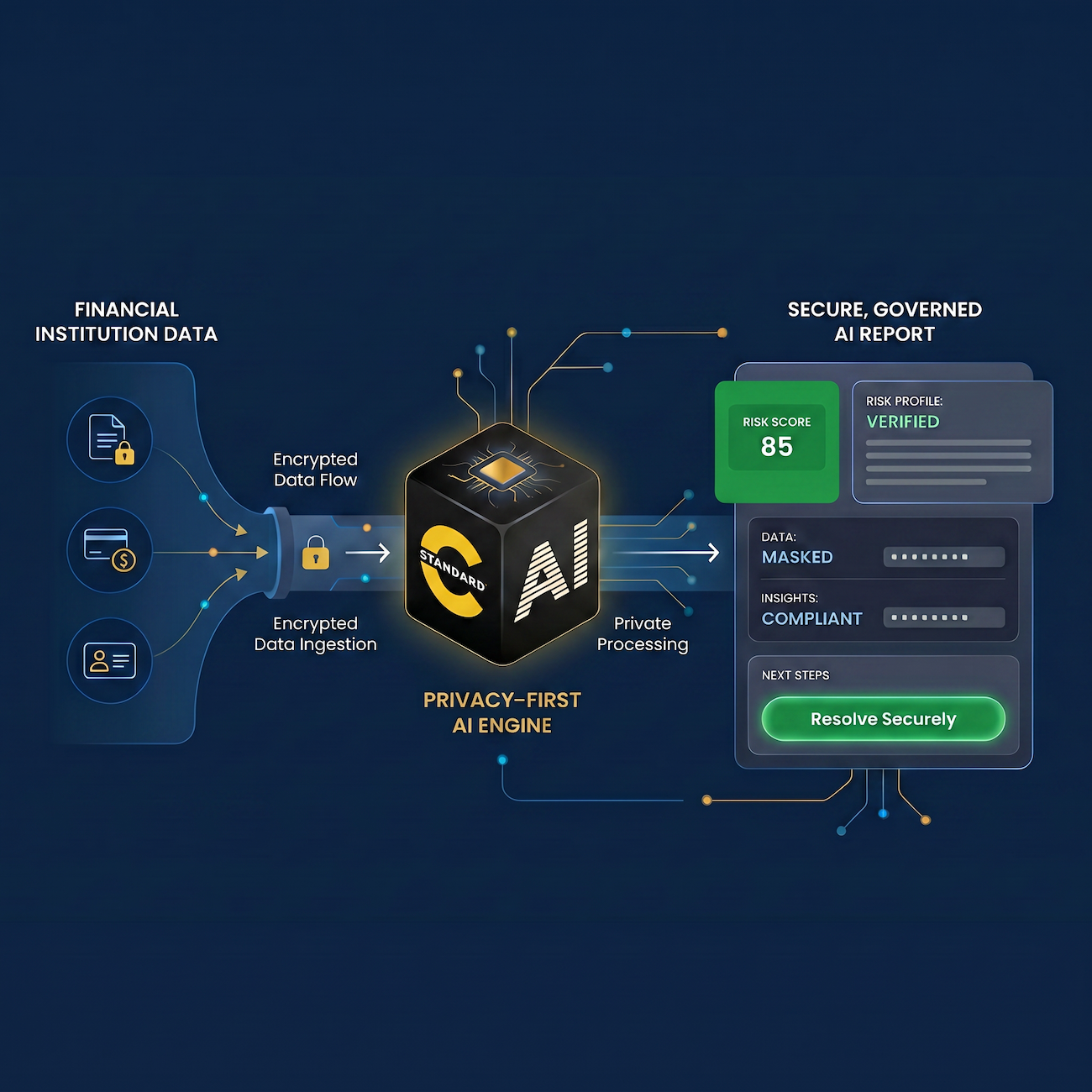
Privacy-first AI is an architectural posture, not a policy statement. The defining characteristic is that data minimization happens structurally, in the pipeline, before any AI model performs inference. Three commitments follow from that posture.
Minimization before inference. Personally identifiable information and other sensitive attributes are removed, de-identified, or reduced to the minimum needed for the analytical question before the model sees the case. The protection does not depend on the model provider behaving well. The provider never receives what it was never sent.
Purpose-bound data flows. Each AI workflow has a defined scope, and the data made available to it is bounded by that scope. A workflow that validates document completeness receives documents, not transaction histories. This is the same principle that underlies the Gramm-Leach-Bliley Act's limits on sharing nonpublic personal information, applied at the level of internal system design.
Provable data handling. The institution can demonstrate, with logs rather than assurances, what data reached which system, when, and under what configuration. If an examiner or a litigant asks what the AI saw, the answer is a record, not a reconstruction.
None of this is exotic. It is the same discipline institutions already apply to wire transfer authority and vault access, extended to a new category of system. What makes it urgent is that AI adoption has raced ahead of it. For a broader introduction, see our overview of what privacy-first AI means for financial institutions.
Part 2: Why the Terms of Service Are Not a Privacy Architecture
The standard enterprise AI arrangement works like this: the institution sends full case data to a model provider, and the provider promises contractually not to retain it, train on it, or expose it. That arrangement has three structural problems.
First, contracts govern conduct, not exposure. Once data has been transmitted, the institution's protection depends on the vendor's operational discipline, its subcontractors, its employees, and its security posture. Samsung learned this in 2023, when engineers pasted proprietary source code into a public chatbot on three separate occasions in a single month. No contract clause retrieves data that has already left.
Second, the regulatory obligation stays home. Under the FTC Safeguards Rule, financial institutions must implement safeguards appropriate to the sensitivity of customer information, and under the Interagency Guidance on Third-Party Relationships, a bank's use of third parties does not diminish its responsibility for the activity. Sending regulated data to a vendor does not transfer the compliance duty. It multiplies the places where the duty can fail. Our playbook on vendor due diligence for AI identity and verification providers covers this in depth.
Third, breach economics are unforgiving. IBM's annual Cost of a Data Breach research has consistently found financial services among the most expensive sectors for breach recovery, with per-incident costs running into the millions. The cheapest record to protect is the one that never entered the exposed system.
The conclusion is not that vendor contracts are useless. Audit rights, data-use restrictions, retention limits, and breach notification clauses remain essential. The conclusion is that contracts are the second line of defense. Architecture is the first.
Part 3: The Regulatory Floor
For financial institutions, privacy-first design is not a differentiator. It is the direction regulation has been pointing for years.
The Gramm-Leach-Bliley Act requires administrative, technical, and physical safeguards for nonpublic personal information, and its Safeguards Rule expects institutions to know where customer data flows and to control access to it. An AI pipeline that transmits full customer files to external models is a data flow, and it will be examined as one.
The Bank Secrecy Act and the Customer Due Diligence rule generate some of the most sensitive records an institution holds: beneficial ownership documentation, expected activity profiles, suspicious activity investigations. These records carry confidentiality obligations of their own, and their handling is squarely within the scope of FFIEC examination procedures.
State privacy law adds a second layer. The California Consumer Privacy Act grants consumers deletion and disclosure rights that are difficult to honor if personal data has been scattered across third-party AI systems, and the California Privacy Protection Agency's regulations continue to sharpen expectations around automated decision-making. Comparable statutes in Virginia, Colorado, Connecticut, and a growing list of other states apply the same pressure. Institutions with international exposure face the same logic in stronger form under the EU General Data Protection Regulation, where data minimization is written into the statute as a named principle.
Model governance expectations complete the picture. The federal banking agencies issued revised interagency model risk management guidance in April 2026 (Federal Reserve SR 26-2, with the OCC's parallel Bulletin 2026-13), superseding the long-standing SR 11-7 framework. The revised guidance is principles-based, but the principles it emphasizes, documented data flows, validation, and controls proportionate to model risk, all presume the institution knows and can defend exactly what data its models consume. For credit workflows, Regulation B adds the adverse action documentation requirements that make untraceable AI inputs a fair lending problem as well as a privacy one. See our guide to aligning AI workflows with model risk management guidelines for the full framework.
Part 4: The Architectural Principles
Organizations evaluating or building privacy-first AI infrastructure should look for five properties. Each one is verifiable, which is the point.
A preprocessing boundary. Sensitive attributes are identified and minimized in a controlled layer the institution governs, before inference. The test is structural: if the preprocessing layer were misconfigured, would the failure be detectable in logs? A policy that asks employees to remove PII by hand fails this test. A pipeline stage fails visibly or works provably.
Data reduced to the analytical question. The model receives what the specific workflow requires and nothing else. Reviewing a financial statement for period-over-period inconsistencies requires the figures and the statements. It does not require the taxpayer identification numbers attached to them.
Deterministic, repeatable handling. The same case processed twice should produce the same data flow and the same output. Repeatability is what turns privacy claims into testable controls, and it aligns with the validation expectations in the 2026 model risk guidance. The case for determinism in regulated workflows is covered in our piece on deterministic AI for cross-document and ownership reconciliation.
Retention and deletion the institution controls. Data used in AI workflows follows the institution's retention schedule, not the vendor's. Deletion on demand should be a capability, not a request ticket.
Logging at the boundary. Every crossing of the preprocessing boundary is recorded. This is what makes the architecture examinable, and it is what allows the institution to answer the question every examiner eventually asks: show me what the system saw. Documentation practices are covered further in how to document AI-assisted decisions for examiner review.
The NIST Privacy Framework and the NIST AI Risk Management Framework both provide useful vocabulary for mapping these properties to enterprise risk programs, and both are voluntary. The properties themselves should not be treated as voluntary anywhere consequential data is in play.
Part 5: Questions to Ask Any AI Vendor
A short list separates vendors with privacy-first architecture from vendors with privacy-first marketing.
- What specific data elements reach your models for each workflow, and can you produce that inventory in writing?
- Where does PII minimization happen, in whose infrastructure, and under whose control?
- Is customer data used to train or tune models, and is that answer contractual or architectural?
- Can identical inputs be replayed to demonstrate identical handling?
- What deletion capabilities exist, and how quickly do they execute?
- Which subcontractors touch the data, and in what jurisdictions?
- What logging exists at the data boundary, and can we export it for examination?
A vendor that answers these questions with specifics is describing an architecture. A vendor that answers with adjectives is describing a brochure. For a structured evaluation process, see AI vendor due diligence for community banks and credit unions.
Part 6: A Readiness Checklist
Before scaling AI in workflows that touch customer or counterparty data, an organization should be able to answer yes to each of the following.
- Sensitive data is minimized structurally before inference, not by employee discipline alone.
- The data each AI workflow can access is scoped to that workflow's purpose.
- Data flows to AI systems are documented well enough to hand to an examiner.
- Retention and deletion of AI-processed data follow the institution's schedule.
- Boundary logging exists and has been tested against a real reconstruction request.
- Vendor contracts back the architecture with audit rights, data-use restrictions, and breach notification, rather than substituting for it.
- Privacy failures in the AI pipeline would surface in monitoring, not in headlines.
Why Privacy-First AI is Imperative
The institutions moving fastest on AI are not the ones that ignored privacy. They are the ones that solved it structurally, early, so that every subsequent workflow inherited the protection instead of renegotiating it. Privacy-first architecture is what allows an institution to say yes to AI in its most sensitive workflows, because the question "what did the model see" always has a short, documented, defensible answer.
Data protection that depends on promises ages badly. Data protection that is built into the pipeline compounds.
Learn More From the StandardC Knowledge Center
Enterprise Risk Strategy
- What Is Privacy-First AI and How Does It Impact Financial Institutions?
- AI Vendor Due Diligence for Community Banks and Credit Unions
- AI-Governed Onboarding and Underwriting Frameworks
- Deterministic AI for Cross-Document and Ownership Reconciliation
- AI-Reinforced KYC and KYB Program Design
- Audit-Ready Identity and Beneficial Ownership Reviews
- AI-Enabled Ongoing Due Diligence and Monitoring
- AI-Supported Onboarding and Underwriting Documentation
- Aligning Intake, Compliance, and Credit Within an Enterprise Risk Framework
Risk Playbooks
- How to Implement AI in Credit Risk Analysis While Maintaining Governance Controls
- How to Perform Enhanced Due Diligence Reviews Using Structured AI Analysis
- How to Use AI for Risk-Based Customer Onboarding in Financial Institutions
- How to Validate AI Outputs in Regulated Banking Environments
- How to Align AI-Supported Workflows With Model Risk Management Guidelines
- How to Conduct Vendor Due Diligence for AI Identity and Verification Providers
Operations Playbooks
- How to Use AI for Business Onboarding in Banks and Credit Unions
- How to Automate Identity Verification Workflows Without Losing Compliance Control
- How to Use AI to Reconcile Cross-Document Data in Loan and Deposit Applications
- How to Structure AI-Assisted Loan Underwriting Reviews for Audit Readiness
- How to Detect Financial Statement Discrepancies Using AI in Underwriting
- How to Scale Compliance Reviews Using AI Without Adding Headcount
Compliance Playbooks
- How to Use AI for KYC Verification in Regulated Financial Institutions
- How to Conduct AI-Assisted KYB Reviews for Complex Ownership Structures
- How to Perform Beneficial Ownership Verification Using Deterministic AI
- How to Use AI for BSA and AML Document Review
- How to Implement AI for Customer Due Diligence and Ongoing Monitoring
- How to Build an AI-Supported Onboarding Program That Meets Regulatory Expectations
- How to Prepare for a Regulatory Exam When Using AI in Compliance Workflows
- How to Document AI-Assisted Decisions for Examiner Review
This guide reflects publicly available regulatory guidance, industry research, and architectural principles relevant to AI deployment in enterprise and financial services contexts. It is intended as a practical reference and does not constitute legal, compliance, or regulatory advice. Organizations should consult qualified advisors for guidance specific to their regulatory obligations.